
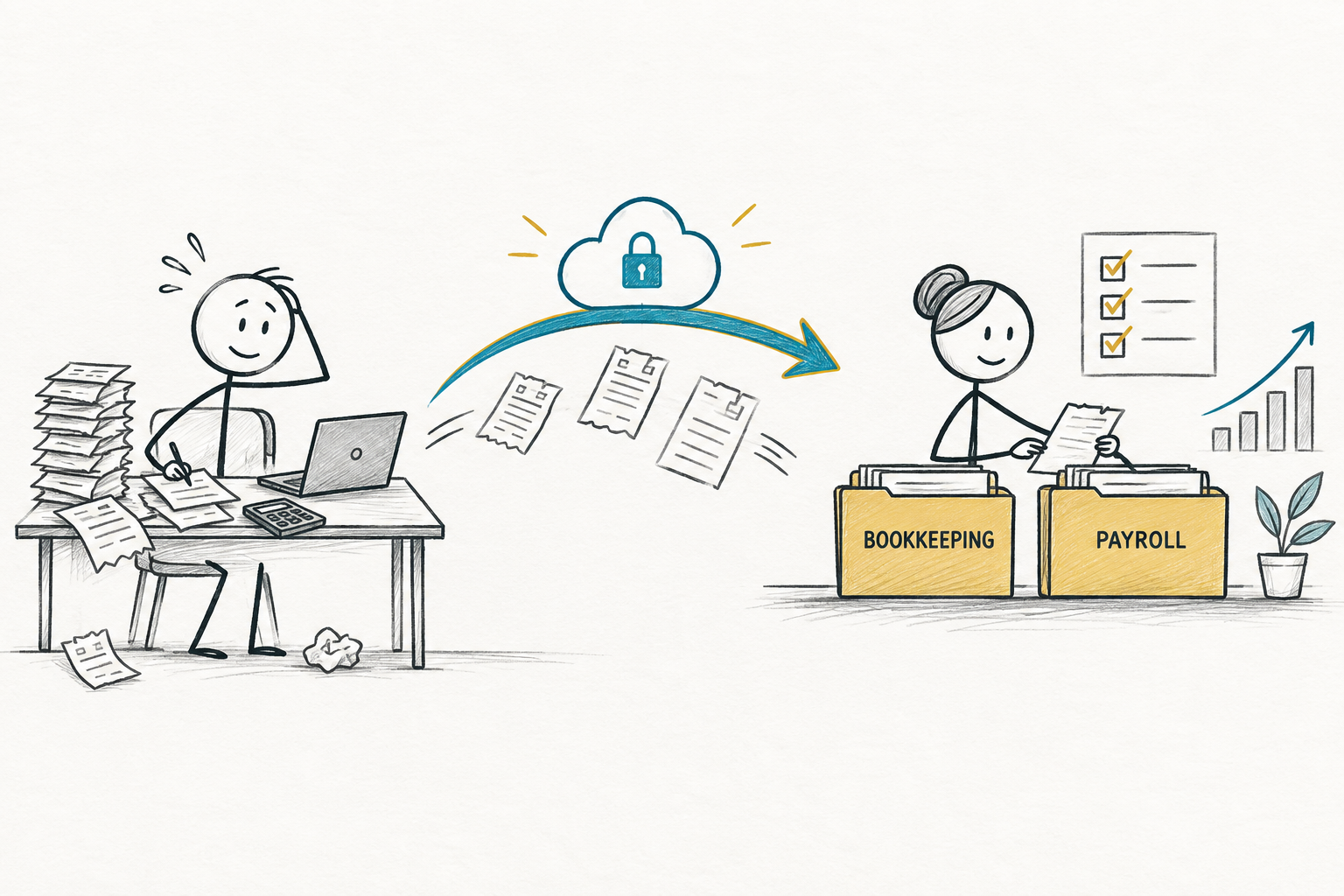
Running a small business involves more than delivering your products or services. There are transactions to record, accounts to reconcile, invoices to follow up and employees to pay.
Many business owners try to manage all of this themselves because they don’t realise bookkeeping and payroll can be outsourced. Others assume outsourcing is only suitable for larger companies.
In reality, a small business can outsource some or all of its bookkeeping without employing an additional staff member. The level of support can be adjusted to suit the size, systems and needs of the business.
What is outsourced bookkeeping?
Outsourced bookkeeping means engaging an external bookkeeping provider to manage agreed financial administration for your business.
Instead of employing someone internally, you provide the bookkeeper with appropriate access to your accounting software and financial records. They complete the agreed work remotely, communicate with you regularly and can liaise with your accountant when required.
The business owner retains access to their accounting system and remains in control of business decisions.
The Australian Government’s business.gov.au website specifically identifies bookkeeping as one of the time-consuming or specialised tasks that businesses can consider outsourcing.
What bookkeeping tasks can be outsourced?
Outsourcing doesn’t have to mean handing over every part of your financial administration. You can choose the areas where you need assistance.
Commonly outsourced tasks include:
Recording and categorising transactions
Bank and credit-card reconciliations
Managing accounts payable and supplier bills
Preparing customer invoices
Monitoring accounts receivable and overdue invoices
Payroll processing and payroll record maintenance
Superannuation administration
Preparing regular financial reports
Maintaining Xero, MYOB or QuickBooks records
Organising financial information for your accountant
Catching up or cleaning up overdue bookkeeping
Some businesses outsource their complete bookkeeping function, while others only need assistance with payroll, reconciliations or a backlog of transactions.
How does outsourced bookkeeping work?
The process usually begins with a discussion about your business, accounting software, current bookkeeping routine and the areas causing difficulty.
The responsibilities and frequency of the work are then agreed. For example, your bookkeeper might reconcile accounts weekly, process payroll fortnightly and provide reports at the end of each month.
Documents can be shared electronically, and cloud accounting platforms allow both the business owner and bookkeeper to access current financial information. Appropriate permissions can be used so each person only has access to the areas they need.
A good outsourced arrangement should give you greater visibility, not less. You should know what is being completed, when it is being completed and which responsibilities remain with you.
Do you need to outsource everything?
No. Outsourced bookkeeping can be flexible.
A sole trader might only need monthly reconciliations and help keeping records organised. A growing employer may need regular payroll and accounts payable support. Another business might be comfortable handling customer invoices but need someone to manage everything behind the scenes.
Starting with one time-consuming area can be a practical way to experience outsourced support before expanding the arrangement.
Why do small businesses outsource bookkeeping?
More time for the business
Bookkeeping often gets completed at night, on weekends or whenever the owner can find time. Outsourcing routine financial administration allows that time to be redirected towards customers, employees and business operations.
More consistent records
When bookkeeping has an agreed schedule, transactions and reconciliations are less likely to build up. Current records also make it easier to understand what the business owes, what customers owe and how much cash is available.
The ATO notes that good business records help businesses monitor their financial position and meet their tax, superannuation and employer obligations.
Better financial visibility
Accurate bookkeeping creates a stronger foundation for profit and loss reports, balance sheets and cash-flow information.
Reports cannot provide a reliable picture when transactions are missing or reconciliations are months behind. Keeping the underlying records current helps owners identify potential issues earlier.
You can read more about this in our guide to cash-flow management for small businesses.
Access to experienced support
An outsourced provider works with accounting systems and bookkeeping processes regularly. This can help a business establish clearer procedures without recruiting and training an internal employee.
Easier communication with your accountant
A bookkeeper can help keep records organised and prepare the information your accountant requires. This creates a useful connection between the business’s day-to-day activity and its accountant.
Could outsourcing bookkeeping cost less than hiring?
For many small businesses, outsourcing can cost less than employing an in-house bookkeeper because the business only pays for the level of support it actually needs.
Jobs and Skills Australia reports median full-time earnings of approximately $1,400 per week for bookkeepers. This is equivalent to about $72,800 per year before employment-related costs.
After adding the current 12% superannuation guarantee, the direct salary and super cost would be approximately $81,500 per year. An employer may also need to consider paid leave, workers compensation insurance, recruitment, training, equipment, software and providing cover when the employee is unavailable.
Outsourced bookkeeping is structured differently. A small business may only require several hours of support each week or a set list of monthly tasks. Rather than carrying the cost of a permanent position, the business pays for an agreed service based on its actual requirements.
This does not mean outsourcing will always be the cheapest option. A business requiring continuous, full-time bookkeeping support may benefit from employing someone internally. However, outsourcing can be a cost-effective alternative for businesses that need experienced and reliable support without enough work to justify a permanent role.
Can payroll also be outsourced?
Yes. Payroll is one of the areas a small business can choose to outsource.
Payroll support may include processing pay runs, maintaining employee information, recording leave, preparing pay slips and administering superannuation payments.
However, outsourcing the processing does not remove the employer’s responsibility for meeting workplace and superannuation obligations. The business should still approve payroll information and notify the provider promptly about changes to hours, pay rates, leave and employment conditions.
Fair Work requires employers to maintain accurate and complete employee records and issue compliant pay slips. This makes clear payroll procedures particularly important.
Will outsourcing mean losing control?
This is a common concern, but a well-managed arrangement should help the owner feel more informed.
You can retain access to your accounting software, approve payments and payroll, review reports and decide which tasks the provider is authorised to perform.
Before work begins, both parties should agree on:
Services included in the arrangement
Responsibilities of the business and bookkeeper
Approval processes
Communication frequency
Software access and permissions
Document-sharing procedures
How confidential information will be protected
Multi-factor authentication, controlled user access and current software are important safeguards when financial information is accessed online.
Signs it may be time to outsource
You may benefit from outsourced bookkeeping if:
Bookkeeping is regularly completed after hours
Bank reconciliations are falling behind
You aren’t confident your reports are accurate
Customer invoices are not being followed up
Payroll is becoming stressful or time-consuming
Your accountant frequently requests missing information
Financial administration is taking time away from customers
The business is growing beyond what you can comfortably manage
You need support but aren’t ready to employ someone internally
You don’t need to wait until the records are significantly behind. Establishing support earlier can prevent a manageable workload from becoming a major clean-up.
Choosing an outsourced bookkeeping provider
Look for someone who takes time to understand how your business operates rather than applying the same process to every client.
Consider their experience, accounting software knowledge, communication style, security practices and ability to work with your accountant. You should also receive a clear explanation of what is included and which tasks remain your responsibility.
The right arrangement should make your bookkeeping easier to understand and give you greater confidence in your financial records.
Flexible bookkeeping support from Alexsar
Alexsar Bookkeeping provides personalised bookkeeping and payroll support based on the needs of each business.
You can outsource a specific area, such as payroll or bank reconciliations, or receive ongoing assistance across your bookkeeping function. We work with Xero, MYOB and QuickBooks and can communicate directly with your accountant to help keep the flow of information organised.
Based in Rouse Hill, we support businesses across Castle Hill, Kellyville, Bella Vista, Baulkham Hills, Norwest and the wider Hills District and North West Sydney. Our cloud-based services are also available to businesses throughout Australia.
Explore our bookkeeping services or request a quote to discuss which parts of your bookkeeping could be outsourced.
Frequently asked questions
Can small businesses outsource bookkeeping?
Yes. Small businesses can outsource only the tasks and frequency they need. Support might begin with monthly reconciliations, payroll or bringing overdue records up to date.
Can outsourced bookkeeping be completed remotely?
Yes. Cloud accounting software and secure document-sharing systems allow most bookkeeping tasks to be completed remotely while the owner retains access to their records.
Can I outsource payroll but keep doing the bookkeeping myself?
Yes. Payroll can be outsourced separately from the rest of the bookkeeping function, provided responsibilities and approval procedures are clearly agreed.
Will an outsourced bookkeeper work with my accountant?
They can. A bookkeeper can maintain the day-to-day records and organise the information your accountant needs, helping create a clearer connection between your business and accountant.
Can I outsource bookkeeping if my records are already behind?
Yes. An initial catch-up or clean-up can be completed before establishing a regular bookkeeping schedule.
Clear Books. Clear Direction.
