
Employing an In-House Bookkeeper vs Outsourcing: What Does It Really Cost?
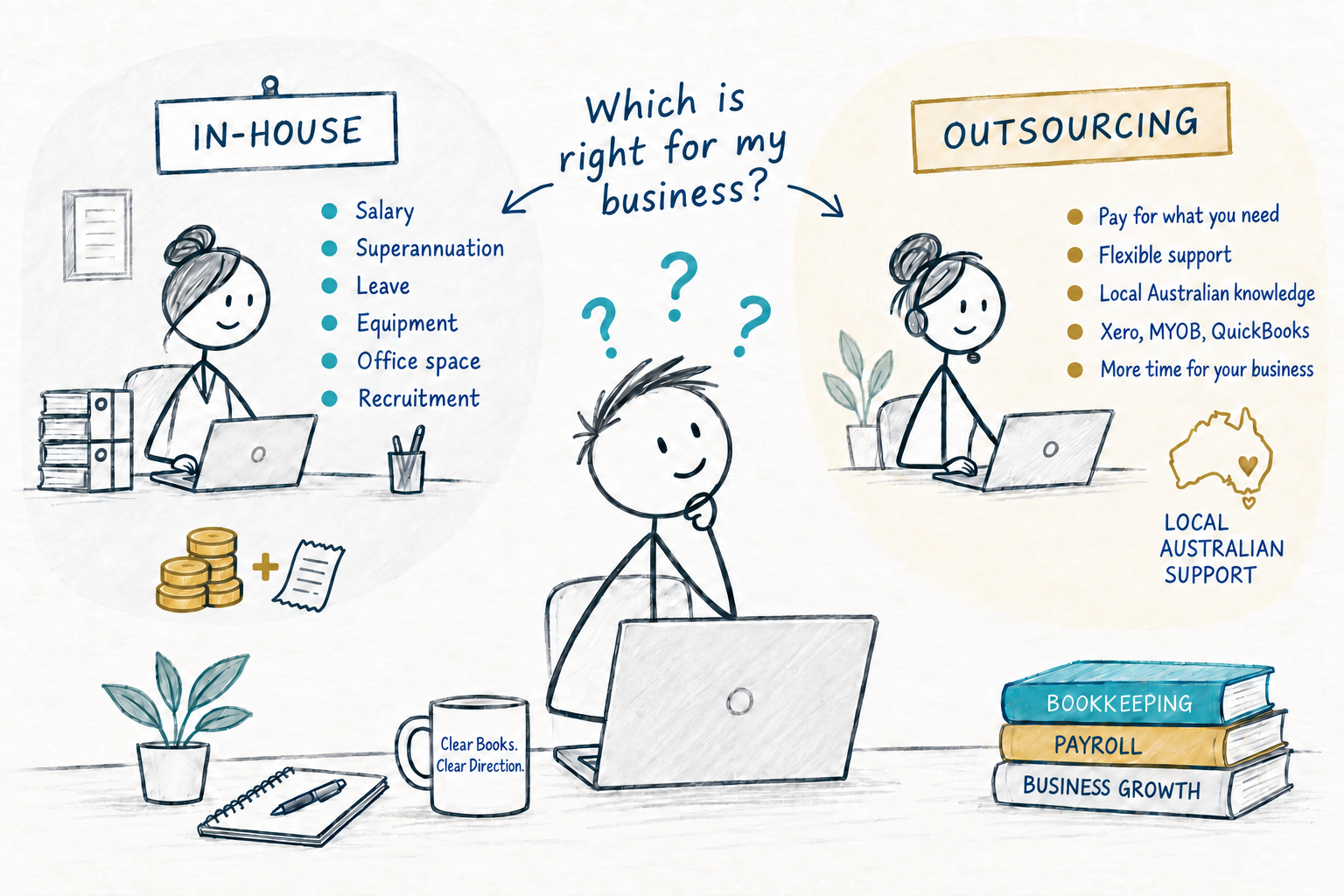
As your business grows, bookkeeping can quickly become another significant responsibility.
Eventually, many business owners face a decision: Should you employ a full-time bookkeeper or outsource the work to an external bookkeeping provider?
Both options have their place. But for many small and medium-sized businesses, the key question is whether there is actually enough bookkeeping work to justify employing someone full-time.
What does a full-time bookkeeper really cost?
When employing someone, the cost to the business is more than their salary.
For example, consider a full-time bookkeeper earning $70,000 per year.
With superannuation at 12%, salary and super alone would be approximately:
| Example annual cost | Amount |
|---|---|
| Salary | $70,000 |
| Superannuation (12%) | $8,400 |
| Salary + super | $78,400 |
There may also be other employment costs such as paid leave, workers compensation insurance, recruitment, training, equipment, software and management time.
So the real question becomes: Does your business actually need a bookkeeper for 38 hours every week?
How could outsourcing compare?
With an outsourced bookkeeper, you generally pay for the level of support your business actually requires rather than maintaining a full-time position.
Using an illustrative rate of $80 per hour:
8 hours per week = approximately $33,280 per year + GST
10 hours per week = approximately $41,600 per year + GST
Compare that with our full-time example:
| Example | Approximate annual cost |
|---|---|
| Full-time employee – salary + super | $78,400+ |
| Outsourced – 8 hrs/week | $33,280 + GST |
| Outsourced – 10 hrs/week | $41,600 + GST |
These examples exclude the effect of GST credits. GST-registered businesses may be able to claim a GST credit on eligible outsourced bookkeeping fees, subject to their circumstances and ATO requirements.
These are examples only, and actual salaries, rates, hours and employment costs will vary.
The important point is that: A higher hourly rate doesn't necessarily mean a higher overall cost.
If your business only requires several hours of bookkeeping each week, outsourcing may allow you to pay for the support you actually need rather than carrying the cost of a full-time position.
Other benefits of outsourcing
Cost isn't the only consideration.
Outsourcing can reduce the time involved in recruiting and onboarding another employee, while giving your business flexibility to adjust the level of bookkeeping support as it grows.
An experienced bookkeeper may also bring knowledge of accounting platforms such as Xero, MYOB and QuickBooks, established bookkeeping processes and experience working with different types of businesses.
Most importantly, regular bookkeeping support can give business owners more time to focus on customers, employees and running the business.
Why choose a local Australian bookkeeper?
Outsourcing doesn't necessarily mean sending your bookkeeping overseas.
Offshore providers can sometimes offer lower hourly rates, but there are benefits to working with someone who understands the Australian business environment.
A locally based bookkeeper is more likely to be familiar with Australian bookkeeping practices, payroll and superannuation processes, and how businesses work with their accountants and BAS agents.
Being in the same or a similar time zone can also make communication easier when you need to ask a question or resolve an issue.
And with cloud accounting systems such as Xero, MYOB and QuickBooks, your bookkeeper doesn't need to sit in your office.
You can have the flexibility of outsourced bookkeeping while still having the accessibility and local knowledge of an Australian-based provider.
When does an in-house bookkeeper make sense?
Outsourcing isn't right for every business.
If you have a high volume of transactions, substantial accounts payable and receivable activity, or enough financial administration to keep someone productive throughout the working week, employing a full-time bookkeeper may make good commercial sense.
But if your business only needs bookkeeping support for part of the week, outsourcing can be a more flexible alternative.
Before deciding, ask yourself: How many hours of bookkeeping work does the business genuinely have each week, and do we really need someone for 38 hours?
Considering outsourcing your bookkeeping?
If you're wondering how outsourced bookkeeping works in practice, read our guide: Outsourced Bookkeeping and Payroll: How It Works for Small Businesses.
Alexsar Bookkeeping provides personalised bookkeeping, payroll and superannuation support, bank reconciliations, accounts payable and receivable, financial reporting, and Xero, MYOB and QuickBooks support.
We’re based in Rouse Hill, North West Sydney, and your bookkeeping is handled here in Australia, not outsourced overseas.
We support businesses throughout Sydney and across Australia using cloud-based accounting systems, giving you the flexibility of outsourced bookkeeping with the personal service and local knowledge of an Australian-based team.
Clear Books. Clear Direction.
